I recently visited the Galapagos Islands as part of my honeymoon in Venezuela and Ecuador. It was an experience like nothing else and I would recommend that anyone who is considering going there to book their trip today!
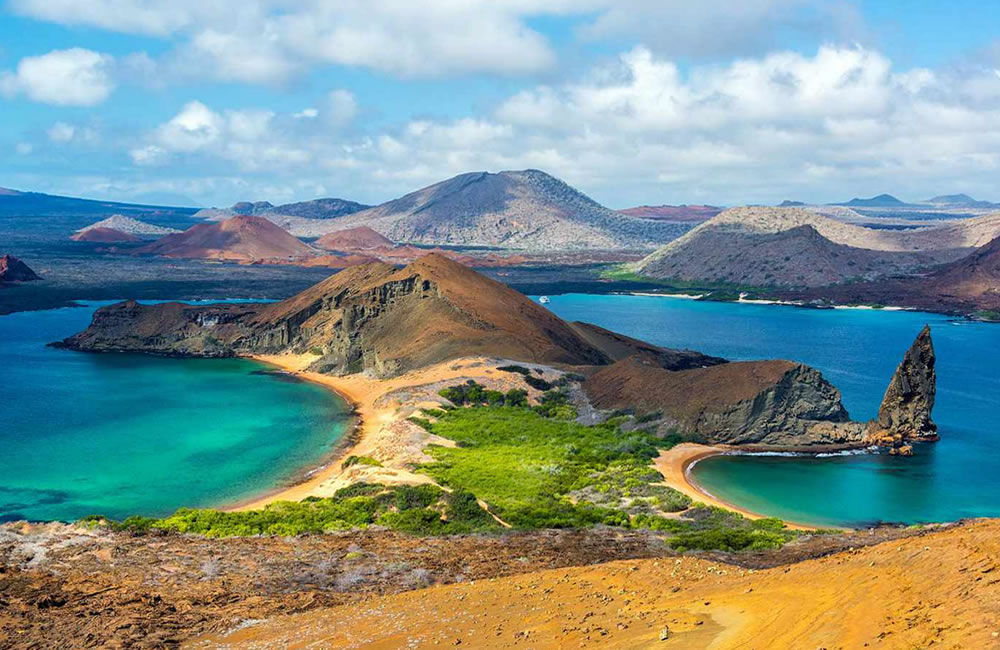
The defining moment was when my wife and I spent an hour snorkeling off the island of Bartolome, one of the few islands where you can see penguins.
During that hour we swam with turtles, rays, penguins, sharks and a multitude of fish. I had never experienced anything like this before and it was something which will remain with me forever.
Located roughly 1000 miles West of Ecuador, the Galapagos Islands are famed for being a prime location for viewing wildlife in an environment which has been largely undisturbed by human development.
Unfortunately the popularity of this wildlife haven threatens to be its downfall, with increasing visitor numbers and conflicting interests between the conservationists, the fishing industry and an increasingly mobile domestic and international tourist market. Added to this is a rapidly expanding population which has boomed since the 1980’s due to the rapid growth of the tourism and fishing industries. To give an idea of the scale of this growth, the population until 1980 was less than 5,000 with 4,000 people visiting the islands each year. In 2006 there is a resident population of 28,000 (increasing at 6.5% p.a.) and around 100,000 visitors a year.
My lasting memory of our time in the Galapagos was our first day on Santa Cruz, the most populated island of the archipelago. To get to the nearest beach from Puerto Ayora, the main town on the island, a path has been created though two and a half kilometres of cactus forest. This is a small indication of where some of the $100 park fees have been spent and is a wonderful way of seeing some of the rugged landscape of Santa Cruz. When we arrived there I was initially disappointed that the second beach, which was safe for swimming, was at the end of a long lagoon-like channel that went out to sea round a headland covered by mangroves. As far as swimming went, the water was extremely shallow until you waded out to about thirty metres from the shore. The water was still only four or five feet deep so we stood still, just taking in the surroundings.
My first realisation that we weren’t alone was when I saw an eagle ray move off the bottom just inches from where I was standing. As I was describing this to my wife we saw another shape moving through the water. As it got closer we realised that it was a green turtle. The turtle only diverted from its course when it was only a few feet away from us and noticed that we were standing in its path.
By now we were captivated and were standing rigid with anticipation of what we might see next. In the next ten minutes we saw about ten turtles swimming around us, occasionally coming up to breathe and making a gasping sound as they did so. As we were marvelling at this incredible experience I saw something new break the surface. Unlike the turtles this animal was moving very close to the surface and it wasn’t until it finally breached the surface that we saw the unmistakeable markings of a white tip reef shark. Part of the attraction and the reason why we had such a great time was due to the fact that we were on a boat with a group of interesting people and there were only 16 of us. On most days we only saw one or two other boats of a similar size but on occasions there would be as many as sixty people on one beach, albeit in different groups.
My experience of the Galapagos Islands was shaped by those moments when we were alone on the water or in a group with our guide. The difference between this and landing on a beach where there are already fifty people in the water all snorkelling towards one turtle was vast.
I was horrified to read in an article in the Guardian (19th April 2006) that a 650 berth cruise ship, the Discovery, will this week set sail for the Galapagos. The reason for my distress is twofold. Firstly I think that the environmental impact of large cruise ships in the Galapagos has to be extremely detrimental compared to smaller vessels carrying a fraction of the number of people.
When we were on our tour of the islands I spoke to Raoul, our guide, about how this is affecting local people. His feeling was that boats registered in Guayaquil and other places outside of the Galapagos were effectively taking money out of the hands of local people.
Crewed by mainland Ecuadorians or foreigners and supplied with produce outside of the Galapagos, these boats are effectively bypassing any form of economic development on the islands and are utilising their resources for next to nothing.
Secondly I think that tourism in the Galapagos needs to focus on preserving not only the wildlife and its environment but most importantly the experience of viewing that wildlife so that it is a personal and individual experience. Having hoards of tourists descending on a small island will totally destroy the experience of seeing the wildlife of the Galapagos up close and personal and for me this was reason why it was so special.